What is a burner phone, and when does it make sense to use one?


Burner phones are often seen as a simple privacy fix, but what they actually do (and don’t do) can be unclear. It’s easy to assume they provide full anonymity, when in reality, everyday use can still link them back to the user.
This article explains how burner phones work in practice, where their privacy limits are, and how to use them more effectively. It also covers common setup pitfalls and key tradeoffs between smartphones and basic phones.
What is a burner phone?
A burner phone is a phone or a phone number meant for temporary, low-commitment, or compartmentalized use. It's often paired with a prepaid service rather than a long-term contract, and may be used on a basic handset, a prepaid smartphone, or an existing unlocked phone with a separate SIM or eSIM.
The SIM card is typically used with prepaid service for calls and texts, sometimes through a short-term plan, and can be replaced or discarded when it's no longer needed. The phones themselves are often inexpensive, and the term ‘burner’ comes from the idea that the phone or number can be used temporarily and then dropped.
Some burners are simple models with limited apps and connectivity, focusing on core functions like calling and texting. But not all burner phones are basic handsets: many are prepaid smartphones, and some feature phones still include limited internet access, apps, Wi-Fi, or GPS.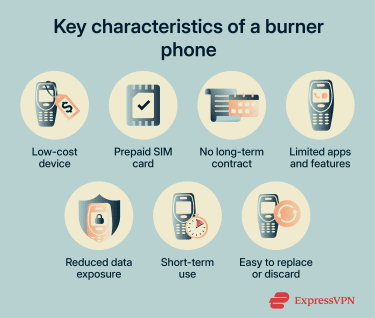
Why do people use burner phones?
People use burner phones in situations where they want to keep their primary phone number separate or use a secondary line for a specific purpose:
- Privacy for sign-ups and short-term use: Burners are handy for online orders, one-time registrations, or services that require phone verification. Using a disposable number instead of one linked to banking or email can help keep a primary number more private, especially given the frequency of data breaches.
- Spam prevention: Phone numbers can fall into the hands of advertisers, data brokers, scammers, or robocallers. A throwaway number can help shield the main line from unwanted calls and messages.
- Work–life separation: A second phone keeps work calls and messages from bleeding into personal time, making it easier to set boundaries after hours.
- Temporary communication: Contractors, freelancers, and online sellers may use a burner to communicate with short-term contacts or for one-off projects.
- Travel: A prepaid phone or local SIM can help avoid roaming costs abroad. A burner also doubles as a backup device if a primary phone is lost, stolen, or dead, and basic phones tend to last significantly longer on a single charge, which can be useful in emergencies. However, local SIMs aren't always anonymous, since some countries require ID for activation.
Can burner phones be tracked?
Burner phones are less private than many people assume. They can make it harder to link a secondary number to a person in the short term, but they don’t make someone untraceable. Here’s how tracking, monitoring, and data collection can still apply when using a burner phone.
A burner phone can still be linked to your identity
A burner phone doesn’t guarantee full anonymity. All mobile devices have unique identifiers, including an International Mobile Equipment Identity (IMEI) for the device and an International Mobile Subscriber Identity (IMSI) tied to the subscriber or SIM. Carriers use these identifiers to manage devices and users on their networks, and over time, they can help associate a device or number with a specific person.
At the end of 2020, roughly 72% of mobile subscriptions globally were prepaid, according to GSMA, and some 160 governments had mandated prepaid SIM registration, typically requiring ID at the point of purchase or activation.
Some countries also require device registration in certain circumstances. For example, Pakistan requires registration for devices used with local SIMs in covered cases, and Turkey requires registration for certain phones brought from abroad for local use. In other regions, such as the U.S., there's no federal requirement for prepaid SIM users to register.
Because of this, a burner phone doesn’t automatically separate your identity from your number or device. The level of separation depends on local regulations, the provider, and how the phone is set up and used.
Burner phones can still be located
Burner phones may have limited internet access and fewer sensors than smartphones, but they can still be located through carrier networks. Because prepaid services use the same cellular infrastructure as regular plans, tower- and cell-site-based location methods still apply.
Here’s how it works: phones connect to nearby cell towers to maintain signal, handle calls, and send texts. As the device moves, carriers can generate records based on the towers the phone connects to, placing it within a general area at a given time. Depending on the network and circumstances, those records can help narrow down the phone’s approximate location.
Calls and texts can still be traced
Carriers typically store metadata for network operation and related legal or compliance purposes. This can include details such as call time, duration, and cell-site or tower information, which can contribute to a partial location history.
Over time, this data can reveal patterns. Repeated activity, such as calls made from the same locations or along regular routes, can make it easier to associate a number with a specific person, even if the burner number changes. Using a burner phone alongside a primary device can also create links between the two; for example, if both devices repeatedly connect to the same cell towers at the same time.
This data is primarily used to route calls and messages correctly and manage network traffic, not to monitor users. In rare cases, authorities may access it as part of an investigation. In the U.S., the Supreme Court's 2018 Carpenter v. United States ruling held that law enforcement generally needs a warrant to access historical cell-site location information, though rules vary by country and exceptions may apply.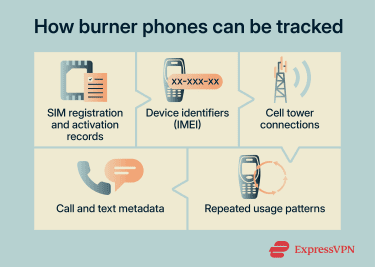
What are the pros and cons of a burner phone?
Burner phones can be useful for specific use cases, but they're not perfect for everyone. Weighing the pros and cons can help you decide whether a burner phone fits your needs or whether other privacy approaches are more suitable. Here’s a quick checklist:
Pros of using a burner phone
- Low cost: Basic handsets and prepaid SIMs are often inexpensive, making them practical for short-term or one-off use.
- No contracts: Prepaid plans typically don't require long-term commitments or credit checks.
- Less exposure to spam and breaches: Using a separate number can help keep your main one off sign-up forms and reduce how widely it's shared with third parties.
- Reduced linkage to a primary number: Activity on a burner may be less directly tied to your main number, depending on how the phone and SIM are bought, registered, and used.
- Easier separation: A second phone makes it simpler to draw a line between work, personal, and travel communication.
- Reduced identity links: In places where ID is not required for prepaid SIM purchases, a burner can add some distance between your number and your identity. However, this depends heavily on local rules.
Cons of using a burner phone
- Metadata still exists: Carriers log call times, durations, and cell tower connections regardless of the phone type.
- ID may be required: Many countries require identification to purchase or activate a prepaid SIM.
- Fewer features: Some burners, especially basic phones, lack the apps and capabilities of a smartphone.
- Linking risks: Everyday habits (like carrying a burner alongside a primary phone) can create patterns that connect the two devices.
Can you use a smartphone as a burner phone?
You can use a smartphone as a burner, but with tradeoffs. Compared to basic phones, smartphones typically generate more potential data trails because they support more apps, internet-connected services, and location-related features such as GPS, Wi-Fi, and Bluetooth. This can make it easier to link activity back to a device over time.
However, smartphones also support apps that protect the content of messages and calls, which may suit users who prioritize communication privacy over minimizing data exposure.
Beyond upfront costs, smartphones and burner phones have distinct security and risk profiles and are better suited to different use cases.
End-to-end encrypted apps offer more privacy than SMS
Smartphones commonly support apps like Signal and WhatsApp, which offer stronger privacy through end-to-end encryption (E2EE). This means only the sender and receiver can access the content, not the provider or anyone trying to intercept it. Telegram also offers E2EE, but only in its Secret Chats mode; regular Telegram conversations aren’t end-to-end encrypted.
By comparison, SMS and MMS are not end-to-end encrypted. Some newer messaging services, such as those that support Rich Communication Services (RCS) chats, may offer stronger protection in certain cases, but that depends on the app and setup.
These apps also send messages and calls over the internet rather than through carrier networks, which can make a smartphone more versatile depending on your needs. Messaging apps support a wider range of content, including voice notes, media, and larger files. In contrast, many basic phones are more limited in what they can send and what they can run.
Note: Some minimalist phones try to bridge the gap by offering fewer apps and features, while still supporting encrypted messaging. Examples include Punkt and Wisephone, but these devices can cost much more than a very basic prepaid phone.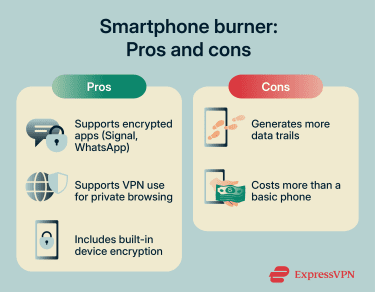
VPNs protect internet traffic while reducing some tracking
Unlike basic phones, smartphones have internet access, which enables more everyday uses. While this means greater data exposure, virtual private networks (VPNs) can improve privacy for those who want protection without sacrificing connectivity.
VPNs add an extra layer of encryption to your internet connection and route traffic through secure servers, which can improve online privacy in several ways:
- Masking your IP address: Websites use IP addresses to locate and distinguish users.
- Changing your apparent location: A VPN can change the IP-based location that websites and services see, which may affect content recommendations and reduce some location-based tracking.
- Hiding browsing activity from your internet service provider (ISP): Your ISP can no longer see which websites and services you access through the encrypted VPN tunnel, though the VPN provider may still be able to.
- Reducing ad tracking: Advertisers and analytics services have a harder time linking activity by IP address, though cookies, browser fingerprinting, and account logins can still be used for tracking.
- Protecting data on public Wi-Fi: Encrypted connections help reduce the risk of interception on open networks.
- Blocking unwanted content: Some VPNs can block trackers, ads, or malicious domains, depending on the provider.
While a VPN won’t hide device information, app activity, or account activity, it can reduce how much of your browsing is visible to local networks and ISPs.
Stronger device and data protection on smartphones
Since basic phones have limited internet access, exposure to many online threats is reduced. On the flip side, they also offer fewer built-in security features. Many include simple PIN locks, but smartphones generally provide stronger protection for stored data, apps, and account access.
For example, if messages or contacts are stored on the SIM card (often the default for many older models), they may be readable by inserting the SIM into another device or a SIM card reader.
Smartphones, by contrast, typically store messages and call logs in internal memory and offer built-in protections, such as screen locks, app-permission controls, and storage encryption. Modern iPhones and Android phones include strong encryption features, and passcodes help protect access to the encrypted data. Some Android phones also support encrypting adopted external storage, such as an SD card.
Despite the broader data collection, smartphones also let you limit some of that exposure. You can disable location services and adjust key mobile privacy settings, like app permissions, camera and microphone controls, and personalized services.
Read more: The ultimate guide to phone security: How to protect your mobile device.
How to use a burner phone: a practical setup
How you buy, set up, and use a burner phone can influence how easily it’s linked to other activities over time.
How to buy a burner phone
Burner phones are usually listed as feature phones, basic phones, flip phones, or prepaid phones. You can find them at most electronics stores, major retailers, carrier stores, and online marketplaces. Some retailers also sell them in convenience-focused locations such as airports or travel hubs, though availability varies.
Some prepaid phones come bundled with a SIM card. Otherwise, you’ll need to buy a SIM separately or activate an eSIM, depending on the device and carrier.
In the U.S., retailers like Walmart or Target sell prepaid phones for as little as $20–30, often with a SIM card included. These phones are typically locked to a specific carrier network, such as Tracfone or AT&T. Paying with cash or a prepaid card may reduce the personal information tied to the purchase itself, but that doesn't prevent linkage through activation, device identifiers, carrier records, or how the phone is used.
In other regions, like across Europe, it’s more common to buy SIM cards separately. Prices typically range from €10–€40, based on credit and validity period. You can find SIM cards at carrier stores like Vodafone, Orange, O2, and EE, depending on the country.
How to set up and use a burner phone
The basic setup process varies by device and carrier, but usually includes:
- Insert or activate the SIM card: Power off the phone, remove the back cover and battery, and insert the SIM card. If the phone is locked to a specific carrier, use the first SIM slot to avoid compatibility issues. Replace the battery and power the phone on.
- Activate the service: Wait for the phone to connect to the network. You may need to enter a PIN, scan a QR code, or complete activation online. Some services work shortly after insertion, while others require additional setup or payment.
- Confirm the phone is working: Check for signal and a carrier name, then place a test call or, if supported, send a test text.
- Minimize unnecessary linkage: Avoid tying the phone to personal accounts or recovery methods if the goal is to keep it separate from your primary number. Keep in mind that carrier records and local SIM-registration rules may still apply.
- Secure the device: Set up a PIN or passcode if the phone supports it. On some phones, contacts may be stored on the SIM card, so review storage settings if that matters for the intended use.
Disposing of a burner phone
To dispose of a burner phone, start with a factory reset to remove messages, contacts, call history, apps, and files from internal storage.
Next, remove the SIM card and any memory card, since those can still hold data after a reset. If the goal is simply to stop using the number, removing or deactivating the SIM may be enough. If the device will not be reused, recycle it through an electronics recycling program or drop-off point. Some retailers offer e-waste drop-off boxes where you can leave the device without providing personal details.
FAQ: Common questions about burner phones
What is the point of a burner phone?
Do burner phones still exist?
How much does a burner phone cost?
Are burner phones anonymous?
Can I buy a burner phone without a contract?
Is a burner phone the same as a prepaid phone?
Is a cheap smartphone better than a burner phone for privacy?
Take the first step to protect yourself online. Try ExpressVPN risk-free.
Get ExpressVPN