
Expressvpn Glossary
Certified Information Systems Security Professional

What is Certified Information Systems Security Professional (CISSP)?
Certified Information Systems Security Professional, or CISSP, is a globally recognized cybersecurity certification issued by the International Information System Security Certification Consortium (ISC2) for experienced practitioners. The certification is used by organizations to assess senior-level security competence across different environments.
How does CISSP work?
CISSP certification is issued by ISC2, the leading member association for cybersecurity professionals. It’s intended for professionals with paid work experience who pass a proctored exam and meet a series of formal requirements.
The CISSP certification process includes:
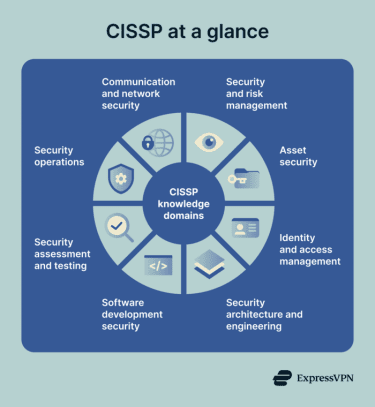
- Proving knowledge of eight security domains: CISSP is based on a defined body of knowledge covering security and risk management; asset security; security architecture and engineering; communication and network security; identity and access management (IAM); security assessment and testing; security operations; and software development security.
- Passing a proctored CISSP exam: Candidates must pass a supervised exam that evaluates applied security knowledge.
- Verifying required paid work experience: Candidates must have their experience formally validated after passing the exam.
- Agreeing to an ethics code: Certification holders must follow a formal professional code of ethics.
- Maintaining certification via continuing professional education (CPE): CISSP requires ongoing professional education to remain valid.
Why is CISSP important?
CISSP helps organizations identify professionals who can manage risk, design security controls, and align security practices with business needs.
Benefits include:
- Recognized benchmark: CISSP signals broad, cross-domain security expertise.
- Hiring relevance: Commonly referenced for senior security roles and leadership positions.
- Leadership alignment: Maps to responsibilities for leading security programs.
- Ongoing skills validation: Requires continuing education to maintain certification.
- Establishes a common security vocabulary: The CISSP framework facilitates communication between industries.
Where is it used?
CISSP is used in:
- Enterprise security and risk teams: Large organizations use CISSPs to design security programs, manage risk, and align controls with business objectives.
- Government and regulated industries: Public-sector and regulated sectors such as finance and healthcare often reference CISSP for senior security roles.
- Security consulting and managed security services providers: Consulting firms use CISSP to demonstrate credibility when advising on security architecture, audits, and incident response.
- Cloud and infrastructure security: CISSPs help design secure architectures for hybrid and cloud environments.
- Vendor and partner assessments: Organizations rely on CISSPs to evaluate third-party security posture before granting access. That said, CISSP certification alone isn’t a substitute for formal audits or compliance frameworks; organizations typically combine CISSP expertise with standards such as System and Organization Controls 2 (SOC 2) or vendor-specific assessments to make informed decisions.
Further reading
- What is cybersecurity? A simple guide for beginners
- Free cybersecurity courses for protection and education
- Why software security audits matter
- What is threat modeling? 5 steps to boost cybersecurity
- The 7 pillars of zero-trust security